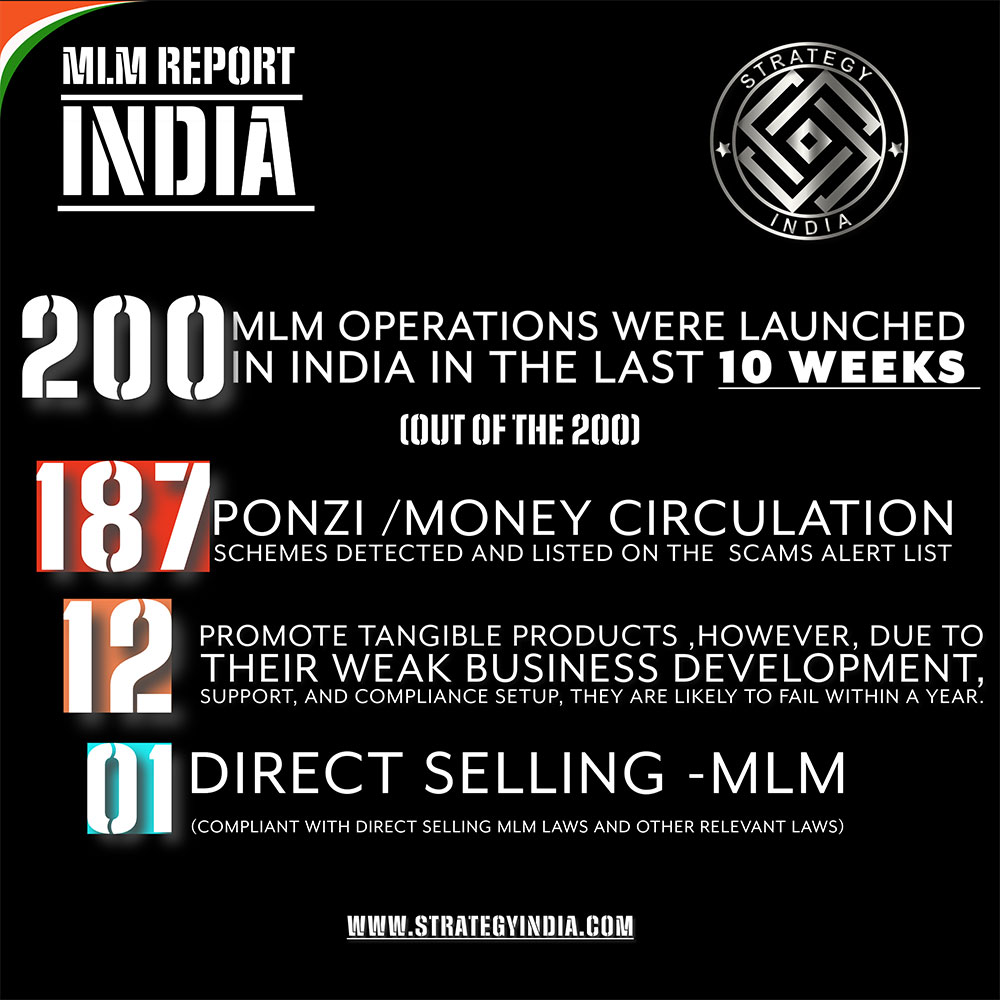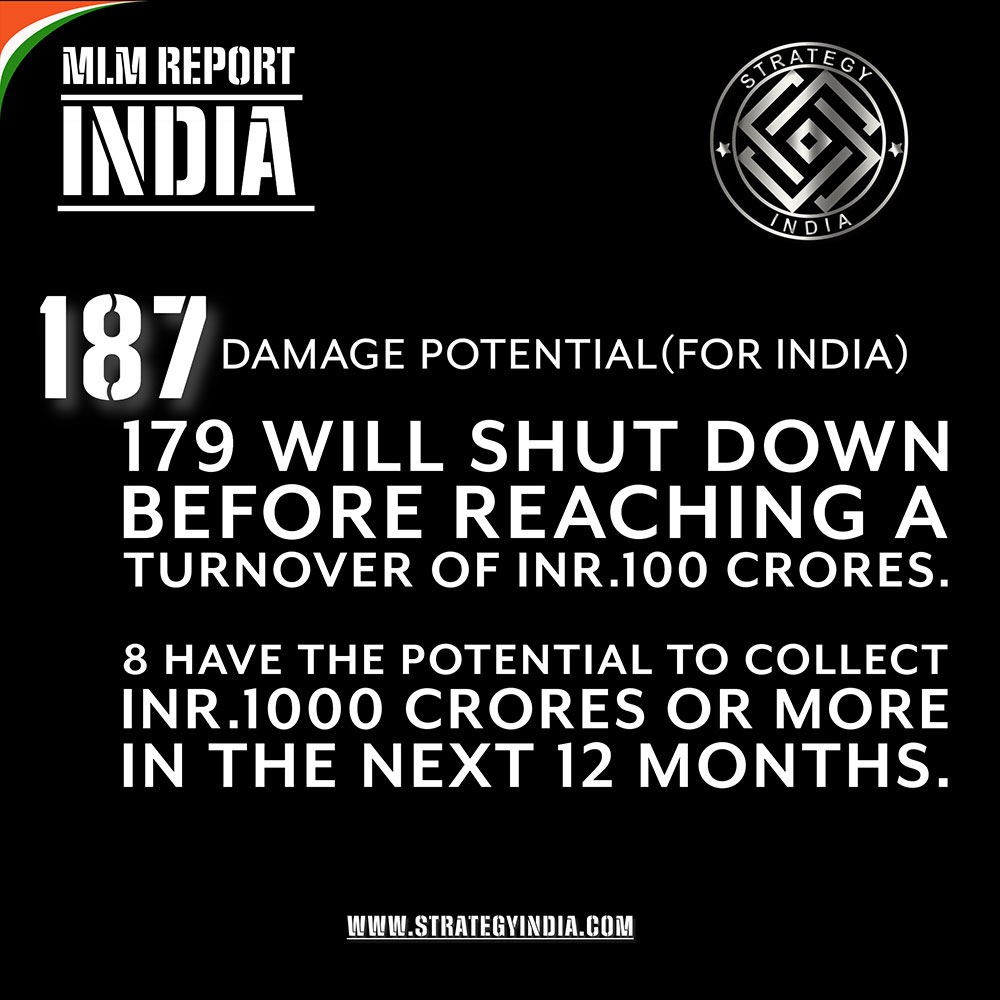
India now has a detailed regulatory framework for direct selling operations that use SLM (single‑level) and MLM (multi‑level marketing) compensation plans. This includes the Consumer Protection (Direct Selling) Rules 2021, the Consumer Protection (E‑commerce) Rules, and anti–money‑circulation legislation such as the Prize Chits and Money Circulation Schemes (Banning) Act and related State laws.
In practice, most prospective participants do not read or fully understand these provisions before deciding whether to join a scheme or a direct selling operation. Many police officers at station level are also not specialists in this subject. Decisions are often made on the basis of trust, social pressure and marketing presentations, rather than on a careful legal assessment.
To bridge this gap, Strategy India had developed and shared with the Indian government a Negative Product List and a Special‑Conditions Product List in 2013-14 for use in connection with operations that deploy an MLM compensation plan.
These lists are based on extensive analysis of MLM operations reviewed by Strategy India over many years and are intended as practical risk indicators for the public, consumers, distributors / direct sellers / networkers and frontline law‑enforcement officers.
- Negative / Special Product List – Eye Opener: https://www.strategyindia.com/negative-product-list.html
- Products to be Promoted Under Specific Conditions: https://www.strategyindia.com/mlm-guidelines-3.html
The following checklist is written in simple language to help an ordinary person take a more informed decision before joining any MLM operation. It is not a substitute for legal advice, but it is consistent with the underlying regulatory principles and Strategy India’s published product guidance.
Pre‑Joining Checklist for Prospective Participants
Please read each question carefully and tick Yes or No based on your own understanding of the scheme that has been presented to you.
Section A – Nature of the “Product”
If you find yourself ticking Yes to several of the risk‑focused questions below, you should treat the opportunity with extreme caution and consider obtaining independent professional advice before proceeding.
1. Is the main “product” one of the following categories that appear on Strategy India’s Negative Product List (see: https://www.strategyindia.com/negative-product-list.html)?
( ) Yes ( ) No
The following examples are indicative:
- Deposits or investments (including “assured return” plans and high‑yield investment programmes)
- Forex, trading packages or other unregulated financial products
- Crypto‑assets, tokens, coins or similar instruments promoted through an MLM structure
- Plantation, livestock or agricultural schemes (for example, EMU, goats, rabbits) offered via MLM
- Real estate plots, car‑advertising income or similar vehicle‑based schemes promoted through a chain
- Discount coupons, holiday vouchers, bid packages or advertising credits sold primarily with income promises
- Online training or e‑learning packages where the content and delivery are unclear or of doubtful practical use to the typical recruit
- “Gifting”, “helping” or crowd‑funding schemes where money is passed between participants without a clear, independently valuable product and a proper tax invoice.
If Yes, this indicates a high‑risk category which, in Strategy India’s experience, has frequently been used to disguise pyramid and/or money‑circulation schemes as legitimate MLM operations.
- Would you still purchase the product or service at the same price if there were no income / earning opportunity attached?
( ) Yes ( ) No
If your honest answer is No, this suggests that your motivation is primarily the promised income or earning potential rather than genuine product value. That is a material risk indicator and is consistent with patterns observed in fraudulent MLM schemes.
Section B – Emphasis of the Business Model
- Is the main emphasis of the presentation on recruiting others into the plan (building a “team” or “downline”) rather than on selling products to genuine consumers?
( ) Yes ( ) No
If Yes, this points towards a recruitment‑driven model rather than a product‑driven business and aligns with characteristics commonly associated with pyramid schemes.
- Are you being encouraged to purchase larger or multiple “packages” primarily to increase your eligibility for bonuses or ranks, rather than because you personally need the additional product or service?
( ) Yes ( ) No
If Yes, this indicates possible “front‑loading” or inventory / purchase loading. Such practices are treated with suspicion (as an indicator of a pyramid scheme) by regulators and courts and are inconsistent with sustainable, consumer‑oriented direct selling.
Section C – Customers and Product Use
- Can the promoters demonstrate that there is a meaningful base of customers who buy the products or services at the stated prices but are not participants in the compensation plan?
( ) Yes ( ) No
If No, and most purchases appear to be made by participants themselves merely to stay “active” or to qualify for commissions, this is a significant red flag that the scheme may be driven by internal consumption (as an indicator of a pyramid scheme) tied to recruitment rather than by genuine retail demand.
- For services such as holiday vouchers, discount coupons or online courses, are the terms and conditions simple, transparent and realistically usable by people in your circumstances (location, income, language, access to technology)?
( ) Yes ( ) No
If No, the practical value of the product is doubtful. The purchase may serve predominantly as a ticket to participate in the income / earning scheme, which is a risk pattern repeatedly observed in Strategy India case studies.
Section D – Refunds, Documentation and Compliance Signals
- Is there a clear, written refund or buy‑back policy (for example, money‑back or buy‑back of marketable goods), consistent with good industry practice?
( ) Yes ( ) No
If No, your downside risk is significantly higher, particularly if you are encouraged to make large upfront or repeat purchases.
- Do you receive a proper tax invoice that clearly identifies the seller, the product or service supplied, the quantity, price and applicable taxes?
( ) Yes ( ) No
If No, this undermines transparency and may indicate poor compliance culture. It will also make it harder for you to pursue remedies or lodge effective complaints later.
- Has the company clearly disclosed on its official website that it does not, and will not, operate any pyramid scheme or money‑circulation scheme, in line with applicable consumer‑protection and direct selling regulations?
( ) Yes ( ) No
If No, or if the promoters dismiss such questions as unimportant, you should be cautious. Genuine direct selling entities are expected to confirm that they do not engage in prohibited schemes.
Section E – Overall Understanding
- After the presentation, can you explain the product and the compensation plan in simple language to a family member within five minutes, without relying on complex charts or assistance from your “upline”?
( ) Yes ( ) No
If No, your decision is likely being made without a full understanding of the risks and mechanics involved. Complexity and lack of clarity are frequently used to mask mathematically unsustainable models.
How to Use This Checklist
This checklist is an awareness tool based on Strategy India’s Negative Product List and Special‑Conditions recommendations and is intended for use by prospective participants, their families and basic‑level field officers.
- Negative / Special Product List: https://www.strategyindia.com/negative-product-list.html
- Products to be Promoted Under Specific Conditions: https://www.strategyindia.com/mlm-guidelines-3.html
It does not in itself determine whether a particular scheme is legal or illegal. That assessment ultimately depends on the full facts and the applicable law.
However, a pattern of “Yes” answers to the risk‑focused questions above should be treated as a serious warning signal that the scheme may be inconsistent with the spirit of direct selling regulations and could, in substance, amount to a pyramid and/or money‑circulation scheme.
Consumers are encouraged to seek independent legal or professional advice where doubt exists. Law‑enforcement officers may treat this checklist and the underlying Negative / Special‑Conditions Product Lists as one of the first tools to help distinguish between genuine product‑based direct selling and operations that appear to rely primarily on recruitment and speculative income promises.