Why MLM Models Have Become a Preferred Tool for Scammers in India
India’s financial fraud landscape is evolving quickly. A key shift is the growing use of multilevel marketing compensation plans by scam operators seeking rapid scale, low visibility, and delayed complaints.
This matters because the issue is no longer confined to old-style chit fund language or simple deposit collection by agents. Instead, fraudsters now use the language of direct selling, entrepreneurship, digital communities, and even crypto education to raise money from the public while sidestepping the scrutiny that normally applies to regulated finance.
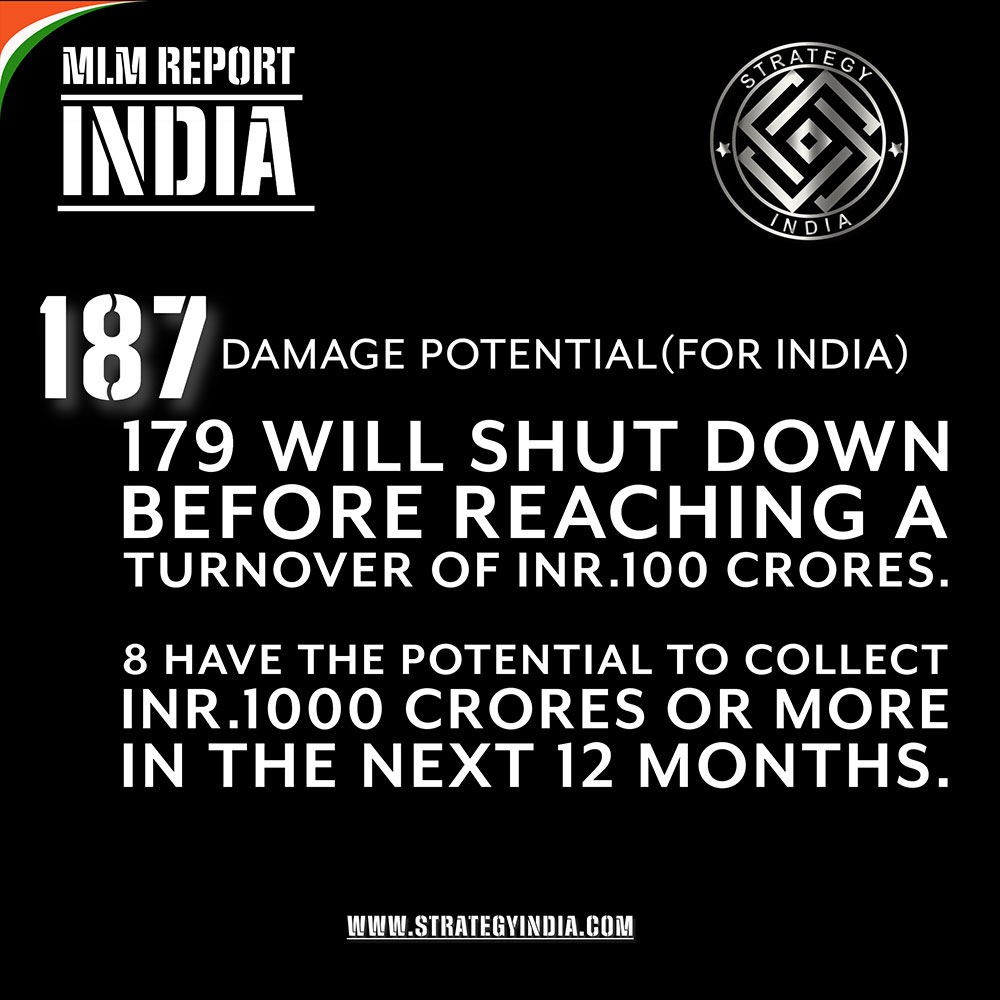
In India, the widespread and deliberate exploitation of MLM compensation plans has become a structural feature of financial fraud rather than an occasional aberration. This is evidenced by the launch of 841 Money Circulation/Ponzi schemes and 46 Pyramid schemes in 2025* alone, all employing MLM architectures to facilitate large-scale deceptive practices.
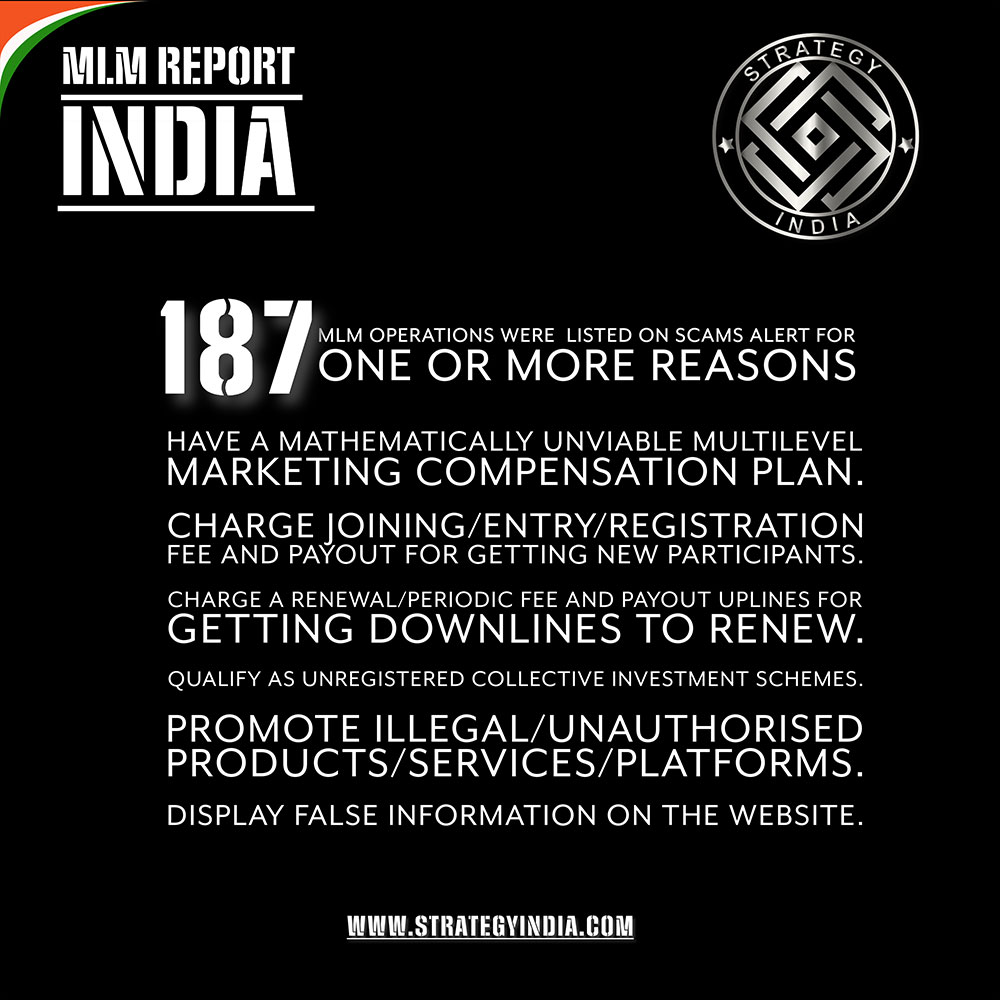
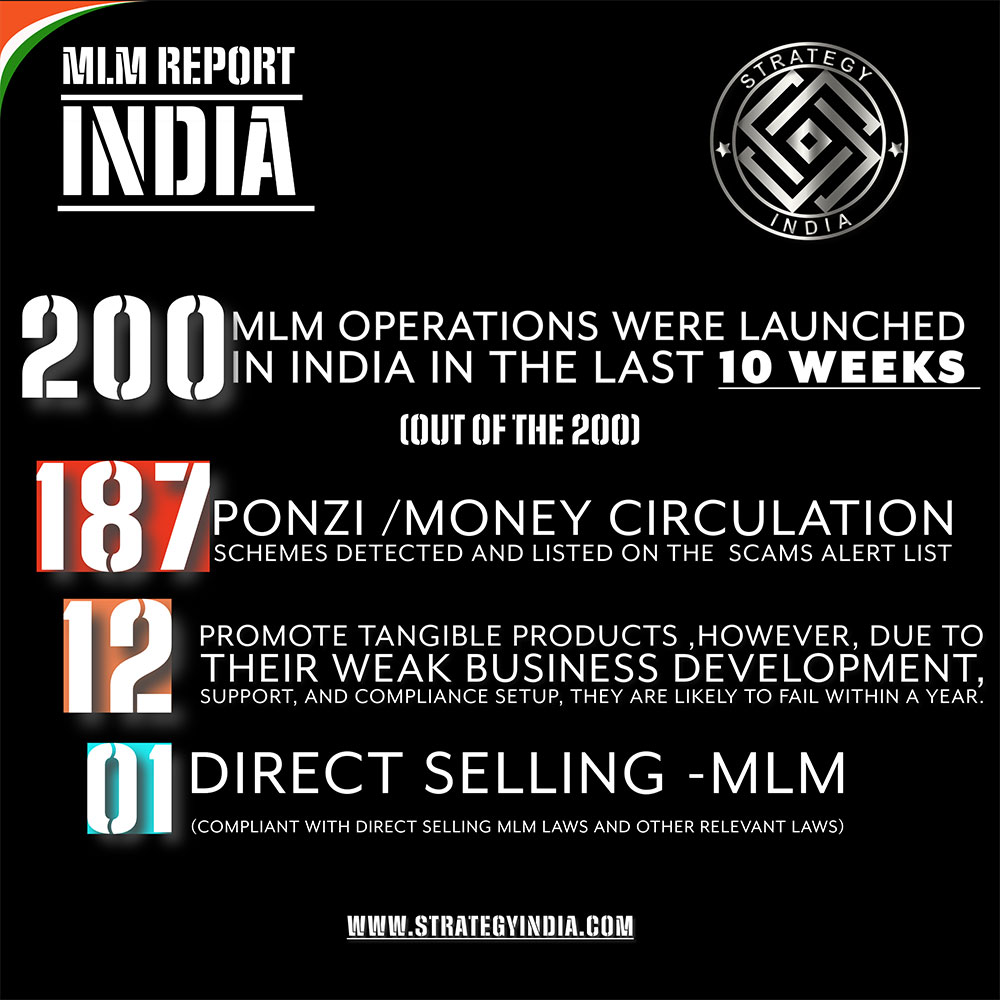
In the first half of 2026, out of 429 new MLM operations launched in India, 397 Money Circulation/Ponzi schemes and 17 Pyramid schemes were detected*, according to data compiled by STAB, a division of Strategy India.
Why MLM structures suit fraud so well
A multi-level marketing structure gives fraud operators three advantages at once: distribution, trust, and distance from liability.
Distribution comes from the network itself. Instead of building branches, hiring staff or paying heavily for public advertising, promoters rely on participants to recruit more participants. Trust comes from the fact that the offer usually arrives through someone known to the target: a friend, relative, colleague, neighbour or local influencer. Distance from liability comes from the layered structure, which allows the promoter to argue that misleading claims were made by “independent members” rather than by the company itself.
That makes MLM particularly useful for fraud. The model can collect money from a large number of people very quickly while making the operation appear to be a private chain of voluntary introductions rather than organised public fundraising.
What an MLM compensation plan really does
An MLM compensation plan is the formal rulebook that decides how participants are paid inside the multi-level network. It sets out who earns from personal sales or purchases, who earns from products or packages moved by people below them, what counts towards rank progression, and how commissions, bonuses, pools and incentives are released.
In a lawful direct selling model, the compensation plan should reward genuine retail demand and transparent distribution activity. The emphasis should remain on actual consumer sales, real product movement and a business structure that does not depend on endless recruitment.
In a fraudulent model, the same framework is calibrated in a very different way. Instead of rewarding real retail demand, it begins to reward new investments, forced subscriptions, wallet loading, joining packages and continued dependence on fresh investors. At that point, the compensation plan ceases to be merely a sales tool and becomes the operating system of the fraud.
Why this is different from a company raising money from investors
This distinction matters. A company that raises funds from multiple investors through recognised legal channels will usually have a defined issuer, identifiable promoters, documented investor rights, audited records, banking trails and a clearer compliance perimeter.
An MLM-style fraud tries to achieve the same economic result, the collection of money from a large number of people, without openly looking like a fundraising activity. People are not described as depositors or investors. They are called members, subscribers, distributors or community participants. That relabelling is not superficial. It weakens the victim’s legal position and helps promoters argue later that no regulated financial activity took place.
Banks and financial institutions operate under strict KYC, AML and reporting obligations. Suspicious patterns can trigger alerts, internal audits, account monitoring and freezing. By contrast, MLM schemes present themselves as direct selling, digital opportunity, community entrepreneurship or education-led platforms, allowing promoters to access retail money outside traditional financial regulation until the damage is already substantial.
There is also no equivalent of depositor protection for MLM participants. Liability is spread across layers of the network rather than concentrated in a recognisable financial intermediary. That is one reason scam operators often prefer MLM architecture to straightforward fund collection.
How the compensation plan delays complaints
One of the least understood aspects of these operations is that the compensation plan is often designed not merely to distribute commissions but also to reduce the likelihood that victims will go to the police.
When the first operation starts to fail, withdrawals are delayed, an internal virtual currency is introduced for payments and transfers within the company ecosystem, and the promoters begin to disappear from public view. The same network is then often migrated to a new company, app, token, or brand. Existing participants are told that their earlier money is safe and will appear as a balance, wallet credit or notional value in the new structure.
That balance is usually no more than a software entry. It creates the impression that the principal remains available even after the funds have already been diverted. The next step is even more damaging: participants are told that they can unlock or recover this old balance only by bringing in new people, generating fresh business volume, or qualifying under the new compensation plan.
This is where the fraud becomes self-protective. The original victim is no longer only a victim. That person is pushed into becoming a recruiter and, therefore, a participant in the next round of the same scheme. Once that happens, the incentive to complain falls sharply. People fear embarrassment, self-implication and social fallout. Many choose silence over police action.
Why these scams stay under the radar
Operations that deploy abusive MLM compensation plans often remain below the radar for extended periods because they do not rely primarily on open advertising. Instead, their strongest promotional channel is word of mouth.
The pitch moves through families, communities, workplaces and trusted circles. The same people who have already invested money become the ones encouraging others to join. That makes early detection much harder than in ordinary financial solicitation.
This is also why large MLM scams can grow faster than expected. They do not look like formal public fundraising. They look like private recommendations between people who know one another. But the economic substance remains the same: mass collection of public money.
Why victims end up funding the defence
Victims of MLM-linked fraud are usually at a structural disadvantage. Unlike customers dealing with a regulated bank or financial institution, they do not have built-in institutional support, clear grievance pathways or a well-defined status as protected financial claimants.
By the time serious complaints are made, promoters have often already used part of the money collected to organise their defence. They hire experienced advocates, create layers of procedural delay, move funds across jurisdictions and put distance between themselves and the original collection story.
This also helps explain a pattern often seen in practice: smaller MLM scams are more likely to be exposed early, while larger scams can survive longer because they move faster, collect more and budget in advance for defence, delay and influence.
The role of crypto and modern money movement
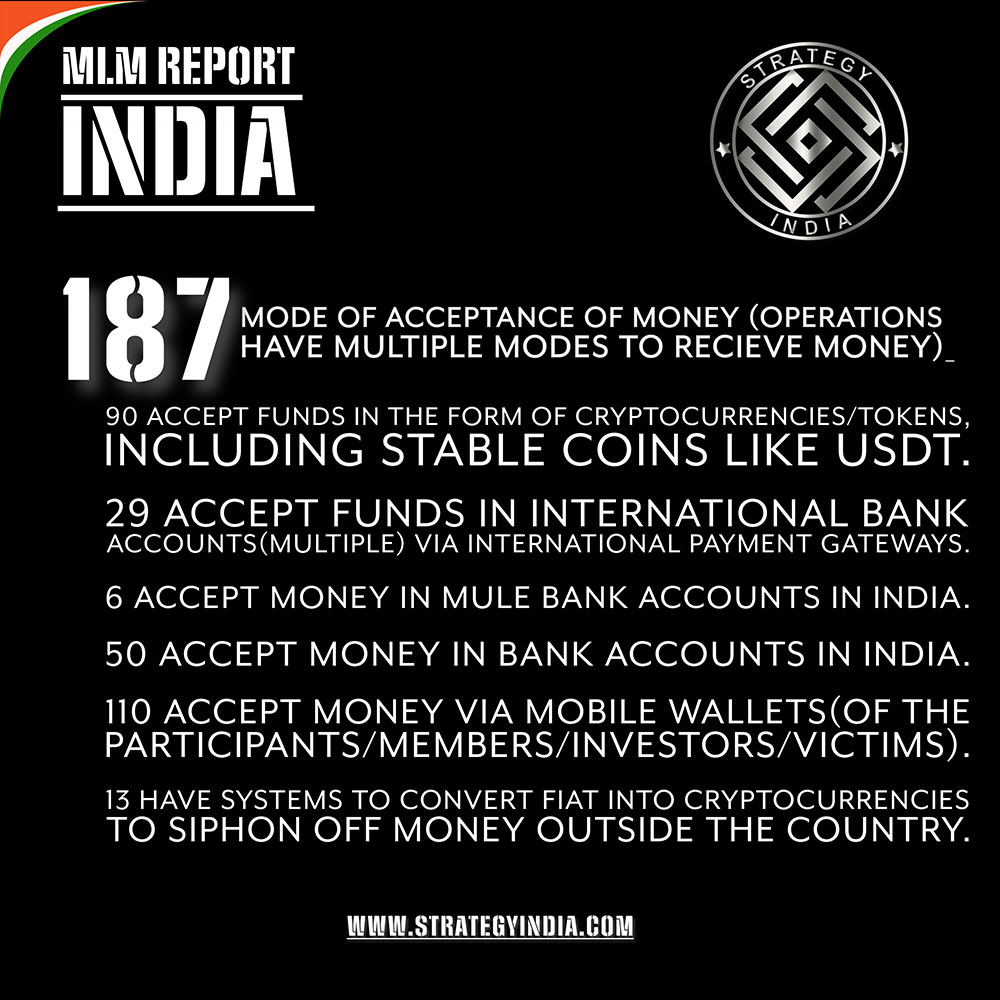
The old model of hawala relied on cash couriers and trust-based settlement. That system still exists, but scam operators increasingly prefer crypto-linked rails because they are faster, cheaper and easier to layer across borders.
Stablecoins such as USDT are especially useful in this setting. Money can enter through bank accounts, UPI channels or payment gateways, then move through mule accounts, shell entities, OTC traders and finally into non-custodial wallets. By the time victims or investigators focus on the local collection layer, a meaningful portion of the value may already have moved outside India or into harder-to-trace assets. Given this cross-border flow, international cooperation becomes critical for tracing, freezing, and recovering laundered funds. Effective collaboration between enforcement agencies across jurisdictions is essential, as assets often move rapidly into global crypto networks where domestic enforcement alone is insufficient.
That is why this is not merely a consumer awareness issue. It is also a financial surveillance and enforcement issue.
What policymakers should focus on
Where the legitimate direct selling industry stands
The remarkable growth of India’s direct selling industry highlights both its economic significance and the challenges it faces regarding public perception. According to the annual survey report of IDSA for FY 2023–24, the Indian direct selling industry recorded an annual turnover of ₹22,142 crores, with around 88 lakh active direct sellers across the country. In FY 2024–25, the market size rose further to ₹23,021 crores, and the number of active direct sellers increased to approximately 93.2 lakh.
These figures matter because they show that there is a large, growing, and formally organised direct-selling ecosystem that is distinct from the abusive schemes described earlier. It is still not clear whether the turnover of pyramid companies is fully excluded from these survey numbers, but even on a conservative reading, the data confirms that millions of people in India are trying to build genuine income streams through compliant direct selling models rather than fraudulent operations.
At the same time, recent research highlights a serious perception problem. The single most critical challenge identified is negative perception: 62% of respondents said their view of direct selling is shaped by negativity, while 48% reported being impacted by Ponzi schemes.
In other words, even when legitimate, product-centric direct selling businesses operate within the law, the reputational harm caused by money-circulation schemes and pyramid structures undermines trust across the entire sector. This situation requires policymakers and industry bodies not only to protect consumers from fraudulent schemes but also to implement policies that differentiate compliant direct selling models from illegal operations, thereby fostering a regulatory environment that supports ethical business practices and addresses public perception challenges.
India does not need to treat every MLM model as fraudulent. But it does need a sharper framework for identifying when an MLM compensation plan is being used to disguise the collection of public funds, suppress complaints, and accelerate laundering.
Several practical priorities stand out.
- Early detection and analysis of operations that deploy MLM compensation plans.
- Closer coordination between consumer protection authorities, economic offences wings, FIU-linked monitoring systems and cybercrime units.
- Better scrutiny of app-based wallet balances, internal tokens and successor-company migration strategies used to recycle earlier victims.
- Faster integration of crypto forensics into mainstream enforcement, especially in cases involving USDT corridors, OTC traders and non-custodial wallets.
- Complaint mechanisms that recognise the reality that many victims have also been used as recruiters and therefore hesitate to come forward.
Generic AI systems, by themselves, are unable to reliably detect and analyse these schemes at their source because they depend on large datasets drawn from publicly available information and predefined patterns. They often fail to capture the nuanced social engineering and recruitment dynamics that occur in encrypted messenger applications, closed social media communities, emails, and SMS loops. They also struggle with limited access to private or ephemeral communications and are not equipped to interpret informal, context-specific language or deception strategies tailored to specific communities. As a result, STAB relies on HUMINT and structured analysis to identify illicit operations early and list them on the SCAM ALERT platform.
In this context, HUMINT (human intelligence) involves directly obtaining information from individuals and informants, as well as through participant observation, within the communication channels where schemes originate and proliferate. HUMINT is indispensable because it can access restricted spaces, interpret evolving group behaviours, and contextualise information that automated tools may overlook. Structured analysis, on the other hand, refers to the systematic organisation, cross-referencing, and analysis of collected data to map relationships, flag suspicious network activity, and detect recurring recruitment patterns. By combining HUMINT and structured analysis, it becomes possible to uncover hidden networks and emerging scams that generic AI tools, constrained by data access and context limitations, would likely miss.
A policy view worth taking seriously
The central point is straightforward. Fraudulent MLM systems do not simply raise money. They create a social and financial architecture that enables fraud to continue even after warning signs appear.
The MLM compensation plan is the key to that architecture. It does not merely distribute rewards. It shapes behaviour, delays complaints, recycles trust and turns victims into the next layer of operators. That is precisely why these models have become so useful to sophisticated scammers in India.
For policymakers, the challenge is to move beyond labels and examine economic substance. When a structure appears to be entrepreneurship on the surface but functions as decentralised public-fund collection underneath, it should be regulated and investigated according to what it actually does, not what it chooses to call itself.
Used responsibly, MLM compensation plans can support a ₹23,000‑crore direct selling industry; used abusively, the same design becomes a double‑edged sword that cuts deepest into the trust and savings of ordinary citizens.
Advance alert platform for Frauds deploying the mlm compensation plans : https://www.strategyindia.com/blog/scam-alerts/
(STAB relies on HUMINT and structured analysis, within applicable legal and ethical frameworks, to identify illicit operations early and list them on the SCAM ALERT platform).